export@electricalelectronicsindia.com +91-8199993101
Global Bulk Tender Supplier - 90+ Countries
Product Detail

Ion Exchange Unit

Code: Environmental0001 · Manufacturer & Exporter from India

Ion Exchange Unit Manufacturer India Click to enlarge Made in India
Lab Catalog Code: ELECTRICLABEnvironmental000199

Ion Exchange Unit

Trusted by 1000+ Institutions Worldwide

Ion Exchange Unit Operation Manual, Lab Instructor Guide and Student Workbook included. Designed for Educational Vocational, Didactic Technical Training Equipment Labs.

  • ISO Certified Manufacturing
  • Bulk Tender Supply Available
  • Complete Documentation Included
  • Worldwide Shipping & Installation
Add to Request List Get Quote
Ion Exchange Unit


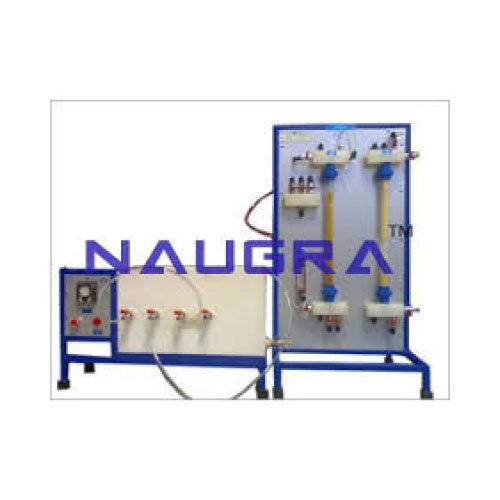
Ion Exchange Unit Two vertical transparent tubes mounted on a backboard contain the
cation and anion resins. A manifold arrangement at the inlet and outlet
to the tubes allows the flow configuration to be changed to simulate the
cycles involved in the operation of a deioniser. Union couplings permit
the tubes to be removed from the manifolds and interchanged for
softening/demineralisation experiments.


Regenerant and test or wash solutions
contained in separate sumps are selected by a traversing tube and
delivered to the apparatus by pump through a control valve and flow
meter. Effluent may be fed to a sump tank and treated water collected in
bottles for tests on hardnes, conductivity or dissolved solids. A
conductivity meter connected to the outlet of the second ion exchange
bed gives a continuous indication of the progress of demineralisation.
The apparatus is supplied with typical commercial cation and anion
resins. Other ion exchange materials may be used so that their
characteristics, exchange capacity etc, may be measured and compared.


Water Softening Theory

The usual ion exchange material employed in water softening is a
sulphonated styrene-based resin, supplied in the sodium form. This has a
strong affinity for calcium and magnesium ions and will also remove
ferrous ions after the almost complete removal of calcium and magnesium.
Softening may be carried out as a batch process by stirring a
suspension of resin in the water until equilibrium or an accepable level
of hardness is reached. It is more convenient to operate as a
continuous flow process, passing the water slowly downwards through a
column of resin beads. The exchange reaction takes place rapidly enough
for the upper layers of the bed to approach exhaustion before the lower
layers are able to exchange ions. Thus there is a zone of active
exchange which moves down the column until the resin at all depths
becomes exhausted. The position at an intermediate stage is illustrated.


When the zone of active exchange reaches
the bottom of the column the emerging water begins to show an
increasing hardness. This is the breakthrough point when it becomes
necessary to regenerate the resin with a strong sodium chloride
solution.


Technical Details

Pump: Self priming diaphragm type

Flowmeter range: 10-80ml/min

Sump tank capacity: 20 litres

Anion exchange resin: 0.75 litre

Cation exchange resin: 1litre


Chemicals required (not supplied):

Sodium chloride

Hydrochloric acid

Sodium hydroxide


Ordering Specification

Self-contained apparatus either for single bed water softening or double
bed system for demineralisation. Two vertical transparent tubes house
the resins. A manifold at inlet/outlet allows flow configuration
changes. Equipment includes pump, valves, conductivity meter and sumps
for regenerant and test or wash solutions. Typical commercial cation and
anion resins are supplied.


Recommended Equipment

Cartridge type water deioniser

Replacement cartridges

Beaker cell


Services Required

Electrical supply:

220-240V/1ph/50Hz

120V/1ph/60Hz


Shipping & Installation

We dispatch Ion Exchange Unit from our Ambala Cantt manufacturing facility to destinations across 90+ countries. All shipments include comprehensive documentation, technical manuals, and a Lab Instructor Guide.

  • Packaging: Export-grade wooden crate with anti-corrosion lining
  • Lead Time: 4-6 weeks for standard orders, customised lead time for bulk tenders
  • Installation: On-site installation and commissioning by our certified engineers (optional)
  • Training: Hands-on training for instructors and lab technicians provided
  • Warranty: 12-month manufacturer warranty against material and workmanship defects
Manufacturing Excellence

Ion Exchange Unit Manufacturers in India

As a leading Electronics Engineering Lab Equipment Manufacturer India, we design and produce Ion Exchange Unit at our state-of-the-art facility in Ambala Cantt, Haryana. Each unit is built using high-quality components, calibrated under controlled conditions and rigorously quality-tested before dispatch.

Our Ion Exchange Unit is engineered specifically for the demanding requirements of engineering colleges, polytechnics, ITIs, vocational training institutes and research laboratories. The equipment supports complete student-driven experimentation with a focus on hands-on learning, theoretical understanding and practical skill development.

We have been a trusted Electrical Engineering Lab Equipment Supplier from India for global bulk tender supply for over two decades, serving Ministry of Education tenders, TVET programmes and skill-development initiatives across 90+ countries.

25+
Years Manufacturing Experience
90+
Countries Served Globally
1,000+
Institutions Trust Our Equipment
ISO
Certified Manufacturing Facility
Quality Standards

Why Choose Our Ion Exchange Unit?

Four pillars of quality that make our equipment the preferred choice for institutional buyers and global tenders.

Engineered for Education

Designed with student learning outcomes in mind — safe operation, intuitive controls, and clear visualisation of underlying principles.

Quality Tested

Every unit passes a strict multi-stage QC process — component verification, calibration, load testing and final inspection.

Worldwide Delivery

Export-grade packaging, complete tender documentation, FOB/CIF/DDP options and reliable shipping to 90+ countries.

Expert Support

Installation, training, after-sales technical support and warranty service from our experienced engineering team.

  • Engineering Colleges & UniversitiesFor undergraduate and postgraduate laboratory courses across electrical, electronics, mechanical, civil and instrumentation departments.
  • Polytechnics & ITIsDiploma and certificate-level practical training labs for skill development and industry-readiness.
  • TVET & Vocational Training CentresSkill-development programmes for ministries of education, labour and vocational training authorities.
  • R&D Centres & Research LabsFoundational laboratory infrastructure for applied research, project work and industrial training.
  • Corporate Training DepartmentsIn-house training facilities at OEMs, utilities, defence establishments and government training academies.
Applications & Use Cases

Where Ion Exchange Unit is Used

Our Ion Exchange Unit is widely deployed across the educational and training landscape. Engineered to handle daily classroom use, year after year, the equipment is trusted by educators, lab supervisors and procurement officers managing institutional bulk requirements.

Whether you are equipping a single laboratory or fitting out an entire engineering campus, this product is designed to deliver consistent performance, support comprehensive curricula, and provide students with the hands-on experience that translates classroom theory into industry-ready skills.

We have supplied this and similar equipment for government MOE tenders, World Bank-funded education projects, Asian Development Bank skill-development programmes and direct institutional purchases — backed by complete tender-compliant documentation.

Frequently Asked

FAQs about Ion Exchange Unit

Common questions from procurement officers, lab managers and faculty about this product.

Yes. We are a registered Electronics Engineering Lab Equipment Manufacturer India and regularly participate in global bulk tenders including Ministry of Education procurement, World Bank, Asian Development Bank and bilateral aid programmes. Our team prepares complete tender-compliant documentation, technical-commercial proposals and FOB/CIF/DDP quotations on request.

Standard orders typically dispatch within 4-6 weeks of order confirmation. For large bulk-tender orders, lead time is agreed in writing as part of the technical-commercial proposal — usually 8-12 weeks depending on order volume, customisation and shipping mode (sea, air or land).

On-site installation, commissioning and training are available as optional services and can be quoted as part of the order. Every unit ships with a detailed Operation Manual, Lab Instructor Guide and Student Workbook so that your faculty can fully utilise the equipment from day one. Remote technical support over phone and email is included free with every purchase.

Yes, we offer customisation including labelling in your local language, panel-layout modification to match your existing lab equipment, additional experimental modules, custom voltage/frequency standards and branded literature with your institution's logo. Share your specifications with our export team and we will revert with a customised proposal within 48 hours.

We provide a 12-month manufacturer warranty against material and workmanship defects from the date of installation. Extended warranty plans, annual maintenance contracts (AMC) and comprehensive maintenance contracts (CMC) are available on request. Spare parts and consumables are stocked at our Ambala facility and are available for global shipment for the lifetime of the product.
 Contact Us